
Guide and checklist
Per stirpes and beneficiary designations: what they mean and how to get them right
The short answer
Per stirpes means that if a beneficiary dies before you, their share goes to their own children, not to the other beneficiaries. Each family line keeps its share. The exact meaning can differ by state and by the wording of the document, so read the definition on your form.
- Per stirpesA deceased beneficiary's share goes to their own children
- Varies by stateThe exact meaning of per stirpes differs by state and by the wording of the document
- Not the willAn account generally passes under its beneficiary form and contract
- 10 yearsGenerally the deadline to empty an inherited IRA, for deaths after 2019, unless the beneficiary is an eligible designated beneficiary
Per stirpes and per capita, with an example
Take a $360,000 account. The owner named their descendants, per stirpes, and has three children: Ana, Ben and Cara. Ana and Ben have died before the owner. Ana left one child. Ben left three. Cara is living.
| Beneficiary | Per stirpes | Per capita at each generation |
|---|---|---|
| Cara (living child) | $120,000 | $120,000 |
| Ana's child (1 grandchild) | $120,000 | $60,000 |
| Ben's three children (each) | $40,000 | $60,000 |
| Total | $360,000 | $360,000 |
The example, side by side
Per stirpes
Per capita at each generation
Bar widths show each person's share of the account. A is Ana's child. B is each of Ben's children.
Under per stirpes, the account is split three ways first, and each deceased child's third goes down their own line. Ben's three children share Ben's third. Under the Uniform Probate Code's "per capita at each generation," Cara takes her third, and the two deceased lines' shares are pooled and split equally among the four grandchildren. The two methods match when every deceased line has survivors in the same generation, as with one deceased child who left living children. They can differ when the lines run to different depths, as Ana's and Ben's do here, because the Uniform Probate Code subdivides at every generation.
Primary and contingent beneficiaries
A primary beneficiary is first in line. A contingent beneficiary takes only if no primary beneficiary survives the owner. On a TOD registration, the firm sets its own terms for naming both, so the options on the form are what counts. An advisor reviewing a form checks whether contingents are named and what should happen if a named person dies first: to their children (per stirpes), to the other beneficiaries, or to someone else.
Beneficiary designation forms and transfer on death forms
- A beneficiary designation form goes to the IRA custodian, plan administrator or insurer and says who receives the account or benefit. The account passes under that form and the account contract, not under the will.
- A transfer on death (TOD) form registers an investment account with a beneficiary, shown with the words "TOD" or "POD" (pay on death). Under the Uniform TOD Security Registration Act, in states that have enacted it, the designation has no effect on ownership until the owner dies, and the owner can change or cancel it without the beneficiary's consent.
- Who can use TOD registration. Under the Act, a security held by one owner, or by joint owners with right of survivorship. Firms are not required to offer it, and each sets its own form and terms.
- Several beneficiaries. Under the Act, beneficiaries who survive the owner hold their interests as tenants in common until the account is divided.
- Real estate is separate. A TOD deed is governed by state law and is not the same form. Check your state.
What happens with no beneficiary
- The agreement sets the default. For an IRA or employer plan, the account agreement or plan document says who is next in line when no one is named. Ask the custodian or plan administrator for it.
- If no TOD beneficiary survives, under the Act the security belongs to the owner's estate.
- An estate is not an individual. For an inherited IRA, the IRS treats an estate as a beneficiary that is not an individual. That can mean a shorter withdrawal period than an individual beneficiary gets. For example, a 5-year rule applies to an estate when the owner died before their required beginning date.
- Then the will, or intestacy law. Property in the estate goes under the will. With no will, state intestacy law decides. Under the Uniform Probate Code, a surviving spouse may take first and descendants share the rest by representation, which the Code defines as per capita at each generation.
Spouses, divorce, trusts and minors
- Spouses in employer plans. In ERISA-covered employer plans, a participant who names someone other than the spouse needs the spouse's written consent, witnessed by a plan representative or a notary public. The consent rules cited here are written for those plans. For IRAs, state marital or community property law may give a spouse rights, so ask an attorney.
- Spouses and inherited IRAs. A spouse who inherits an IRA can generally treat it as their own or roll it over.
- Divorce. Many states cancel an ex-spouse designation on divorce. In Egelhoff v. Egelhoff the Supreme Court held that such state laws are pre-empted for ERISA plans, so the plan generally pays the person named on the form unless a qualified domestic relations order says otherwise. IRAs are generally not ERISA plans, so state law can apply. Advisors usually re-check beneficiary forms after any divorce.
- Trusts. A trust can be named, but for IRA withdrawal rules its beneficiaries count as designated beneficiaries only if the trust is valid, is or becomes irrevocable at death, has identifiable beneficiaries and the trustee gives the custodian the documents it asks for.
- Minors. The owner's child under age 21 is one of the IRS's "eligible designated beneficiaries", and the 10-year rule starts at age 21. Before naming a minor, ask the custodian what it requires. A custodian under your state's Uniform Transfers to Minors Act or a trust are options to raise with an attorney.
Inherited IRAs: who the IRS treats as a beneficiary
For deaths after 2019, the SECURE Act changed beneficiary withdrawal rules. An eligible designated beneficiary is the owner's spouse, the owner's child under age 21, a disabled or chronically ill person, or anyone not more than 10 years younger than the owner. Other individual beneficiaries generally must empty the IRA by December 31 of the year containing the 10th anniversary of the owner's death. If the owner died on or after their required beginning date, annual withdrawals are also due in years 1 to 9. A tax professional should confirm the details for a given account.
For advisors
A beneficiary review for client meetings
When to review
- At onboarding, for every account the client has
- After a marriage, divorce or death in the family
- After a birth or adoption, or when a grandchild comes of age
- After opening a new account or rolling one over
- After a trust is set up or changed, or when estate documents are updated
- At each annual review, as a quick check
What to collect
- For every account: the current primary and contingent beneficiaries, and the share each one gets
- Full legal names, dates of birth, relationships and addresses; Social Security numbers where the form asks
- How each form says a deceased beneficiary's share is handled: per stirpes, per capita or neither
- For a trust: its name, date and trustee, and a copy of the trust document for the custodian
- For a minor: who the custodian or guardian would be
- For an employer plan: whether the participant is married, and a spousal consent if someone else is named
- Whether the account is a TOD registration, and whether your custodian's form offers LDPS
Common mistakes
- An outdated ex-spouse designation. The form still names the former spouse. State law may cancel it for some accounts, but for ERISA plans the named person is generally paid.
- A minor named directly. Ask the custodian what it requires before naming a minor.
- A trust named without its details. The custodian needs the trust documents, and the trust has to meet the IRS conditions for its beneficiaries to count.
- Percentages that do not total 100. Check each tier, primary and contingent, adds up to 100 percent.
- No contingent beneficiary. If the primary beneficiary dies first, the account may fall back to the estate.
- Per stirpes assumed, not checked. The form's own definition and your state decide who shares.
- The estate plan and the forms disagree. The form generally controls, subject to spousal rights and state law.
- Missing the spouse consent in an employer plan.
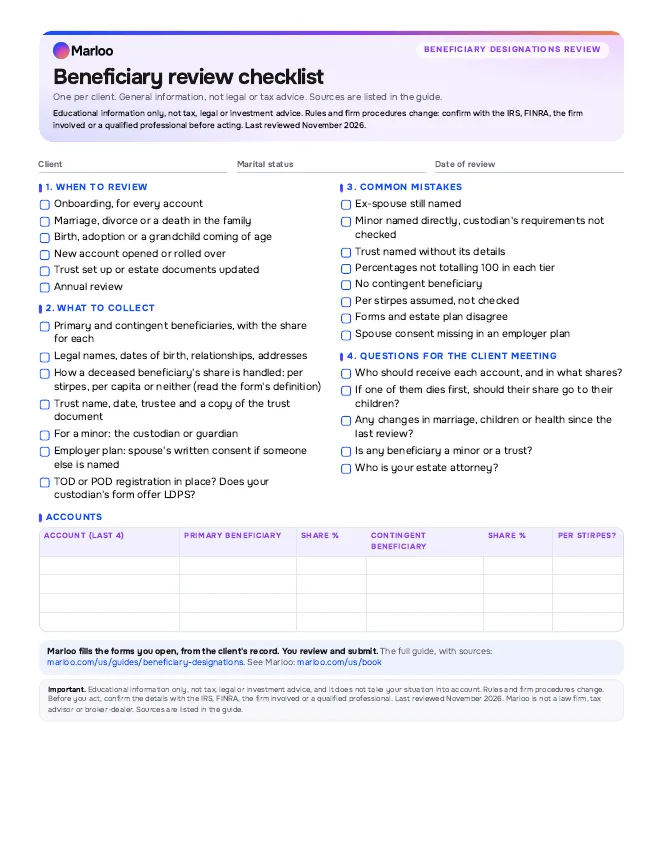
beneficiary review checklist
One page per client: when to review, what to collect, account by account fields and the common mistakes. Print it or keep it with the client file.
Download the PDFOne page, US Letter.
Where Marloo fits
Marloo fills the forms you open, from the client's record. You review and submit. It is the AI CRM for financial advisors, so each client's accounts, beneficiaries and family details sit in one record for the next review.
Filling the beneficiary forms at Schwab and Fidelity
Schwab and Fidelity each have their own beneficiary forms, with their own wording. Both ask for each beneficiary's name, date of birth, Social Security or tax ID number and share. Fidelity's nonretirement transfer on death form has a "Per stirpes" box for each beneficiary: "If you outlive a beneficiary and you want that beneficiary's share to go to his or her descendants, check 'Per stirpes.'" Schwab's Designated Beneficiary Plan Agreement has the owner choose per stirpes or per capita for the account, and says its definitions may differ from state law. Forms change, so check the current one. Whether the client's account is at Schwab or Fidelity, Marloo fills the forms you open, from the client's record. You review and submit.
“I love Marloo it means I can have a conversation without having to worry about taking notes all the way through the conversation. I also love that I can go back to Marloo when a client asks me a question, pop the email into the Ask Marloo feature and it comes up with a draft reply for me.”

Beneficiary questions
Per stirpes means that if a beneficiary dies before you, their share passes to their own children, not to the other beneficiaries. In the strict version, the split starts at the children's level, even if no child is living, and each deceased child's share is divided among that child's descendants. Where the split starts and how the term is defined can vary by state and by the document, so check the wording on your form.
Per stirpes keeps each family line's share together: a child who died is replaced by their own descendants. "Per capita at each generation", the Uniform Probate Code term, pools the shares of the deceased lines and splits them equally among the surviving grandchildren. The two match when every deceased line has survivors in the same generation, as with one deceased child who left living children, and can differ when lines run to different depths. Some forms use "per capita" to mean something simpler, so read the definition on yours.
LDPS stands for "lineal descendants per stirpes". On a transfer on death registration it substitutes a deceased beneficiary's descendants who survive the owner. Who counts as a descendant, and how they share, follows the law of the beneficiary's domicile at the owner's death.
A primary beneficiary is first in line. A contingent beneficiary takes only if no primary beneficiary survives you. On a TOD registration, the firm sets its own terms for naming both, so the options on the form are what counts. It is worth checking what happens if a primary beneficiary dies before you and no contingent is named.
A TOD registration names who gets an investment account when its owner dies, and the account then passes to them by contract, not by will. Under the Uniform TOD Security Registration Act, in states that have enacted it, the designation has no effect on ownership until the owner's death, and the owner can change it at any time without the beneficiary's consent. Firms are not required to offer TOD registration, and each sets its own form and terms.
It is the form that tells an IRA custodian, a plan administrator or an insurer who receives the account or benefit at your death. The account passes under that form and the account contract, not under your will, so the form needs to stay current.
It depends on the account agreement or plan document, which is where the default is set. Under the Uniform TOD Security Registration Act, where no beneficiary of a TOD security survives, the security belongs to the owner's estate. When an IRA passes to the estate, the IRS treats the beneficiary as not being an individual, which can mean a shorter withdrawal period and fewer options. Property in the estate goes under the will. With no will, state intestacy law decides; under the Uniform Probate Code a surviving spouse may take first and descendants share the rest by representation, which the Code defines as per capita at each generation.
Many states cancel an ex-spouse designation on divorce, but the rule differs by state and by type of account. In Egelhoff v. Egelhoff, the Supreme Court held that such state laws are pre-empted for ERISA plans, so the plan generally pays the person named on the form unless a qualified domestic relations order says otherwise. IRAs are generally not ERISA plans, so state law can apply. Advisors usually re-check beneficiary forms after any divorce.
Often yes. In ERISA-covered employer plans, a participant who names someone other than their spouse needs the spouse's written consent, witnessed by a plan representative or a notary public. The consent rules cited here are written for employer plans. For IRAs, state marital or community property law may give a spouse rights, so ask an attorney.
Yes, with care. A trust's beneficiaries can be treated as designated beneficiaries for IRA withdrawal rules only if the trust meets IRS conditions and the trustee gives the custodian the documents it asks for. A minor child can be named. Before doing so, ask the custodian what it requires; a custodian under your state's Uniform Transfers to Minors Act or a trust are options to raise with an attorney. Talk to an attorney before naming either.
No. Each has its own forms and wording, and the form you sign is the one that applies to the account. Fidelity's nonretirement transfer on death form has a "Per stirpes" box for each beneficiary. Schwab's Designated Beneficiary Plan Agreement has the owner choose per stirpes or per capita for the account, says the definition in the form governs how Schwab distributes the assets, and says that definition may differ from your state's laws or your will or trust. Marloo fills the forms you open, from the client's record. You review and submit.
Marloo fills the forms you open, from the client's record. You review and submit.
Sources
Rules come from IRS publications, federal law and state statutes. The Uniform Probate Code and the Uniform TOD Security Registration Act are cited through Hawaii's enactments. Other states' versions differ.
- Uniform Probate Code section 2-709, as enacted in Hawaii (HRS 560:2-709). The code definitions of "per stirpes" and "per capita at each generation", and the date they apply from.
- California Probate Code section 246. A state statute for per stirpes: the split starts at the children, and "by representation" is treated the same way.
- Uniform Probate Code sections 2-103, 2-106 and 2-804, as enacted in Hawaii. Who takes when there is no will or valid designation, and how divorce affects a former spouse named in a governing instrument.
- Uniform TOD Security Registration Act, as enacted in Hawaii (HRS chapter 539). TOD and POD registration: the wording, the effect on ownership, what happens if no beneficiary survives, primary and contingent beneficiaries, and the "LDPS" per stirpes designation.
- IRS Publication 590-B (2025), Distributions from Individual Retirement Arrangements (IRAs). Who is an eligible designated beneficiary, the 10-year rule, estates and trusts as beneficiaries, the trust conditions, a spouse inheriting an IRA, and divorce.
- 26 CFR 1.401(a)(9)-4 and 1.401(a)(9)-5 (final regulations). Age 21 for a minor child of the owner, and annual distributions in years 1 to 9 when the owner died on or after their required beginning date.
- IRS, Retirement topics: Beneficiary. The IRS summary of beneficiary options and the SECURE Act change for deaths after 2019.
- Internal Revenue Code section 417(a)(2). In an employer plan, a spouse must consent in writing, witnessed, before a participant names someone else.
- ERISA sections 205 and 206(d)(3) (29 U.S.C. 1055 and 1056(d)(3)). Which pension plans must protect a surviving spouse, how the spouse consents, and qualified domestic relations orders.
- 29 CFR 2510.3-2(d), individual retirement accounts. IRAs that meet the conditions are not ERISA pension plans.
- Egelhoff v. Egelhoff, 532 U.S. 141 (2001). ERISA pre-empts a state law that cancels an ex-spouse beneficiary on divorce, as it applies to ERISA plans.
- Uniform Transfers to Minors Act, as enacted in Hawaii (HRS 553A-9). How a custodian for a minor is named on an account or policy.