
Guide and checklist
Qualified charitable distributions: the 2026 rules and how to request one
The short answer
A qualified charitable distribution (QCD) is a gift paid straight from an IRA to a charity. If you are 70½ or older, you can give up to $111,000 in 2026 this way. The gift counts toward your required minimum distribution and is left out of your taxable income. To make one, ask your IRA custodian for a QCD, paid directly to the charity, well before December 31.
- 70½Minimum age when the QCD is made
- $111,000Limit per person for 2026
- $55,000One-time split-interest QCD, inside the annual limit
- Paid to charityStraight from the IRA. A check payable to you is a taxable withdrawal
Who can make a QCD
- Age 70½ or older when the distribution is made. That is earlier than the age required minimum distributions start, which is 73 or 75 depending on the year you were born.
- From an IRA. Usually a traditional IRA. An inherited IRA works if the beneficiary is 70½ or older, and so does a SEP or SIMPLE IRA that is no longer receiving employer contributions. A Roth IRA technically qualifies but rarely helps, since qualified Roth withdrawals are already tax-free. A 401(k) or 403(b) does not; the money would first need to move to an IRA.
- Each spouse separately. The limit is per person, and each spouse gives from their own IRA.
The QCD limit
The limit rises with inflation each year. It is per person, per year.
| Year | Annual QCD limit | One-time split-interest QCD |
|---|---|---|
| 2026Current | $111,000 | $55,000 |
| 2025 | $108,000 | $54,000 |
| 2024 | $105,000 | $53,000 |
The split-interest QCD is a once-in-a-lifetime election to fund a charitable gift annuity, charitable remainder annuity trust or charitable remainder unitrust. It counts inside that year's annual limit, and the trust or annuity has to meet extra conditions set out in Pub 590-B.
How a QCD counts toward an RMD
A QCD counts toward the IRA owner's required minimum distribution for the year, and the amount is left out of gross income. So unlike an ordinary withdrawal, it doesn't raise adjusted gross income, which matters for things like Medicare IRMAA brackets.
- Timing matters. A QCD counts toward the RMD for the year it is made, but it can't undo the tax on an RMD already taken as cash. If the plan is to cover the RMD with a QCD, make the QCD before any other withdrawal.
- No double benefit. A QCD cannot also be claimed as a charitable deduction. That is why it suits people who take the standard deduction.
- Deductible IRA contributions after 70½ reduce how much of a later QCD is left out of income.
- Nondeductible contributions in any of the owner's IRAs can mean only part of the gift counts as a QCD. Form 8606 sorts it out.
Work out the year's RMD with the RMD calculator.
How to request a QCD
- Pick an eligible charity and get its legal name, EIN and mailing address. Check it with the IRS Tax Exempt Organization Search.
- Ask the IRA custodian for a QCD, using their distribution or QCD request form. Give the charity details, the amount and the IRA it comes from.
- Have the payment made to the charity. A check payable to the charity can be mailed by the custodian or handed over by you. A check payable to you is an ordinary taxable withdrawal, not a QCD.
- Get a written acknowledgment from the charity, the same kind you would need for a deductible gift, stating that you received nothing in return.
- Tell whoever does your taxes. The custodian reports the distribution on Form 1099-R and may mark it with code Y. Either way, the return has to show it as a QCD: the full amount as an IRA distribution, a taxable amount of zero if it was all a QCD, and the QCD marked where the form asks.
Who the check is payable to
Payable to the charity
Payable to the client
Charities that can't receive a QCD
- Donor-advised funds
- Supporting organizations
- Most private foundations (private operating foundations can)
Most public charities, churches, schools and hospitals can. If you receive something in return, such as event tickets or a dinner, the distribution generally doesn't qualify.
For advisors
Getting a client's QCD right before year-end
What the custodian's QCD request needs
- The charity's legal name, EIN and mailing address
- The amount, and the IRA account it comes from
- Confirmation that the payment goes straight to the charity, not to the client
- Whether the custodian mails the check or the client delivers it
- No tax withholding: none applies to a QCD
- The client's signature, and any memo the charity needs to credit the gift to the donor
Questions to ask in the client meeting
- Which charities do you want to give to this year, and how much to each?
- Do you have each charity's legal name and mailing address? (We'll look up the EIN.)
- Is any of this going to a donor-advised fund or family foundation?
- Have you taken any IRA withdrawals yet this year?
- Which IRA should the gift come from?
- Should the custodian mail the check, or do you want to hand it over?
- Will you receive anything in return, such as tickets or a dinner?
- Who prepares your tax return, so we can let them know?
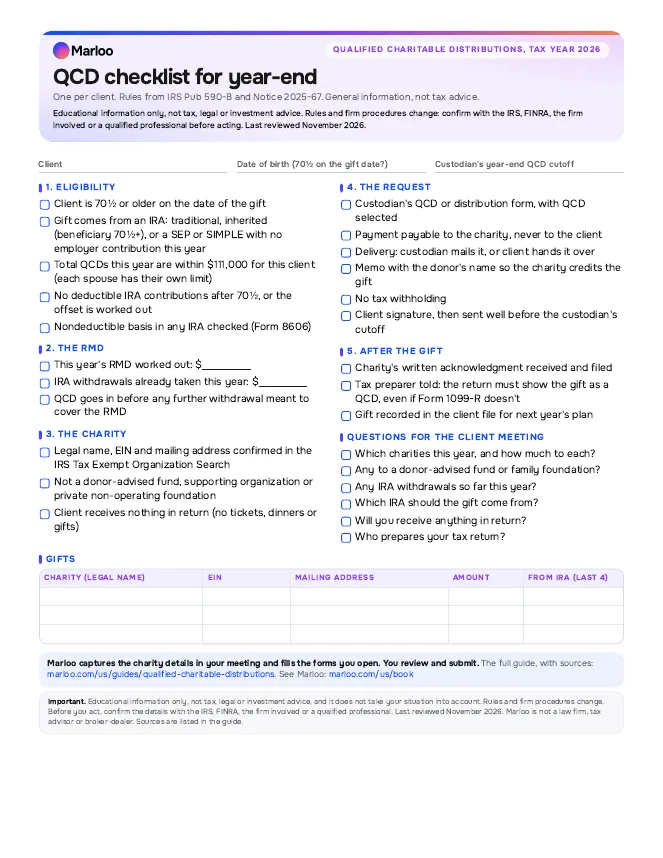
QCD checklist for year-end
One page per client: the eligibility checks, the charity details, the request fields, the meeting questions and what to do after. Print it or keep it with the client file.
Download the PDFOne page, US Letter.
Where Marloo fits
Marloo captures the charity details in your meeting and fills the forms you open. You review and submit. It is the AI CRM for financial advisors, so each client's IRAs, RMDs and giving plans sit in one record for next year too.
Filling the QCD request at Schwab, Fidelity, Pershing or Altruist
Each custodian has its own QCD or IRA distribution request, online or as a form. They all ask for the same details: the charity's name, EIN and address, the amount, and the IRA it comes from. Whether the client's IRA is at Schwab, Fidelity, Pershing or Altruist, Marloo fills the custodian's form you open from the client's record and the charity details from your meeting. You review and submit.
“We thought our existing AI notetaker was great… until we used Marloo. It's a 100% step up in quality, speed and ease of use. The customizable templates are a gamechanger. We've moved the whole Financial Planning team to Marloo.”

QCD questions
A qualified charitable distribution (QCD) is money paid directly from an IRA to an eligible charity. It is left out of the IRA owner's taxable income and counts toward their required minimum distribution. The owner must be 70½ or older when it is made, and can give up to $111,000 in 2026.
$111,000 per person for 2026, up from $108,000 in 2025. The limit rises with inflation each year. A married couple can each give up to the limit from their own IRAs. Within the limit, a one-time QCD of up to $55,000 can fund a charitable gift annuity or charitable remainder trust.
No. QCDs start at age 70½, which is earlier than the age RMDs start (73 or 75, depending on the year you were born). Between 70½ and your RMD age, a QCD is still left out of taxable income; there is just no RMD for it to count toward yet.
Yes. A QCD counts toward the IRA owner's required minimum distribution for the year it is made. It can't undo the tax on an RMD already taken as cash, so if the aim is to cover the RMD with a QCD, make the QCD before taking other withdrawals.
No. The QCD is already left out of taxable income, so it cannot also be deducted. That is why it helps people who take the standard deduction: they get the tax benefit of giving without itemizing.
No to a donor-advised fund or a supporting organization, and no to most private foundations. Most public charities, churches, schools and hospitals can receive a QCD, as can private operating foundations.
The gift has to be completed by December 31 to count for that year. The IRS doesn't say how a mailed check is dated, and IRA custodians set their own year-end cutoffs, so ask the custodian for its cutoff and send the request early.
Yes. Each custodian has its own QCD or IRA distribution request, but they ask for the same details. Marloo captures the charity details in your client meeting and fills the custodian's form you open from the client's record. You review and submit.
The IRA custodian reports the distribution on Form 1099-R, and may mark it with code Y. Either way, you report it on your return: the full amount as an IRA distribution, a taxable amount of zero if it was all a QCD, and the QCD marked where the form asks. Keep the charity's written acknowledgment with your records.
Sources
Every rule, age and limit on this page comes from IRS publications and the tax code. The 2026 limits are the IRS's inflation adjustments for 2026.
- IRS Publication 590-B (2025), Distributions from Individual Retirement Arrangements (IRAs). Chapter 1, "Qualified charitable distributions": the age test, eligible IRAs and charities, the annual limit, the one-time split-interest election, how a QCD counts toward an RMD, and the offset for deductible contributions made after age 70½.
- IRS Notice 2025-67, 2026 limitations adjusted for inflation. Sets the 2026 QCD limit at $111,000 and the one-time split-interest limit at $55,000.
- IRS Notice 2007-7, Section IX (Q&A 34 to 43). IRS guidance on QCDs: inherited IRAs, ongoing SEP and SIMPLE IRAs, checks payable to the charity, no withholding, and counting toward the RMD.
- Internal Revenue Code section 408(d)(8). The statute: eligible charities (excluding donor-advised funds and supporting organizations) and the income exclusion.
- IRS, Instructions for Forms 1099-R and 5498. How the IRA custodian reports a QCD, including code Y in box 7 (new for 2025, optional for 2026).
- IRS, 2025 Instructions for Form 1040, lines 4a to 4c. How the taxpayer reports a QCD: the full distribution, a taxable amount of zero if it was all a QCD, and the QCD box on line 4c.
- IRS, Tax Exempt Organization Search. Check a charity's EIN and status before the request goes in.