
Guide and checklist
Certification of trust: what it is, what it contains and how to open a trust account
The short answer
A certification of trust, also called a certificate of trust, is a short document that proves a trust exists and who the trustee is. A bank or brokerage can use it instead of asking for the whole trust.
- A summaryIn the four states we read, it need not contain the terms that say who receives what
- State lawWhat it may or must contain depends on the state
- Who signsFlorida, Ohio and Arizona: any trustee. California: all currently acting trustees
- Ask the firmA firm's own rules can ask for more than a statute lists
What a certification of trust contains
Trusts are governed by state law, so what a certification may or must contain depends on the state. Several states have a statute on this. The Uniform Trust Code, a model law, includes one, but a model law is law only in states that enacted it, and each state words its own version. California’s section is its own statute. We read the sections for Florida, Ohio, Arizona and California, and they agree on the core: the trustee gives the certification instead of a copy of the trust.
The names vary too. Certification of trust, certificate of trust and trust certification are used for the same kind of document. A firm may also have its own trust certification form. Florida, Ohio and Arizona list what the certification contains. California says it may confirm or contain the items below. This is what each of the four sections lists:
| In the statute | FL | OH | AZ | CA |
|---|---|---|---|---|
| The trust exists, and the date it was signed | Yes | Yes | Yes | Yes |
| Who created the trust (the settlor) | Yes | Yes | Yes | Yes |
| The current trustee | Name and address | Name and address | Name and address | Name |
| The trustee's powers | Yes | Yes | Yes | Yes |
| Revocable or irrevocable, and who can revoke | Yes | Yes | Yes | Yes |
| How co-trustees sign | Yes | Yes | Yes | Yes |
| How title to trust property is taken | Yes | – | Yes | Yes |
| Trust ID number (SSN or EIN) | – | – | – | Yes |
| Legal description of real property | – | – | – | Yes |
| Whether anyone has a power of direction | Yes | – | – | – |
| Statement that the trust has not been revoked, modified or amended to make it incorrect | Required | Required | Required | Required |
| Statement that it is signed by all currently acting trustees | – | – | – | Required |
| Who signs | Any trustee | Any trustee | Any trustee | All current trustees |
| Notary | Not mentioned | Not mentioned | Not mentioned | Acknowledged declaration (see below) |
Swipe sideways to see every column.
FL is Florida Statutes 736.1017, OH is Ohio Revised Code 5810.13, AZ is Arizona Revised Statutes 14-11013 and CA is California Probate Code 18100.5. A dash means the section does not list the item. It does not mean a firm won't ask for it, and these four states are not every state.
All four say the certification need not contain the dispositive terms of the trust, which are the terms that say who receives what. Each also lets the person relying on it assume the facts in it are correct, unless they know otherwise. In Florida the section says such a person is not liable to any person for so acting
, and the other three say much the same.
When you need one
A certification is the document a trustee gives when a third party needs proof of the trust without the full instrument. Three settings:
- Opening a trust account. The firm needs to know the trust exists, who the trustee is and what the trustee can do.
- Retitling an account into a trust. Florida, Arizona and California let the certification state how title to trust property is taken, which is the wording the account will carry.
- Real estate. California lets the certification include a legal description and be recorded with the county recorder. Ohio has a separate recordable instrument, a memorandum of trust, that the trustee acknowledges (Ohio Revised Code 5301.255). Whether a title company wants one or the other is a question for the title company or an attorney.
Certification of trust, full trust agreement, affidavit or abstract
Full trust agreement and certification of trust
Full trust agreement
The whole instrument
Includes who receives what. A recipient can rely on a certification without reading this.
Certification of trust
A summary of the facts a third party needs
Carries a statement that the trust has not been revoked, modified or amended in a way that would make it incorrect.
- Full trust agreement. The whole instrument, including who receives what. The point of the certification is that a recipient can rely on it without reading this.
- Certification of trust. A summary of the facts a third party needs, with a statement that the trust has not been revoked, modified or amended in a way that would make it incorrect.
- Affidavit of trust or abstract of trust. Names that firms and states use for similar summaries. We did not find one definition that applies everywhere, so ask the firm what it needs the document to say and whether a certification of trust will do.
Who signs, and is it notarized
- Florida, Ohio and Arizona: any trustee may sign it or otherwise authenticate it. The sections do not mention a notary.
- California: the section says the certification is an acknowledged declaration signed by all currently acting trustees. An acknowledgment may be made before a notary public, and the notary's certificate verifies only the signer's identity (Civil Code 1181 and 1189). Confirm the detail with a notary or attorney.
- Any state: a firm can ask for a notarized signature or for something else its own procedures call for, so the question for the firm is what it will accept before the trustee signs.
How to open a trust account
Each firm has its own application and document list. These are the pieces to settle.
- Ask the firm for its trust account application and its list of documents. Ask also whether it takes a certification of trust, uses its own trust certification form or wants other trust pages.
- Get the certification of trust signed. Check who signs under the state's statute and whether the firm wants a notary. If the trust has co-trustees, the certification says how they sign.
- Settle the tax ID. A trust can have its own EIN. A revocable trust with one living grantor can sometimes use the grantor's name and Social Security number instead: the IRS says the trustee of certain grantor-type trusts does not need an EIN if the trustee gives payers the grantor's name and taxpayer identification number and the trust's address. Under the federal regulation (26 CFR 1.671-4), a husband and wife who file one joint return count as one grantor, and a trust treated as owned by two or more grantors must furnish the trust's own name, TIN and address. The trust's tax preparer or attorney confirms which applies. A broker-dealer collects a taxpayer identification number before it opens an account, with an exception for a customer who has applied for one (31 CFR 1023.220).
- Have each trustee’s identification ready. For an individual, a broker-dealer's identity program collects a name, date of birth, address and identification number, and may verify with an unexpired government-issued photo ID. For a customer that is a trust, it may use documents showing the trust exists, such as the trust instrument. The rule defines the customer as the person that opens the account, and a broker-dealer can also look to the individuals who have authority or control over it (31 CFR 1023.100(d) and 1023.220(a)(2)(ii)(C)). Ask whose identity the firm will verify.
- Agree the account title. Use the wording the firm gives you, and check that the trust's name and date on the application match the certification. In Florida, Arizona and California, the certification may state how title is taken.
- Add a trusted contact. FINRA Rule 4512 has a FINRA member ask for a trusted contact person at account opening. The rule says the account can still open if the customer does not give one.
- Sign and submit. Each person signs where the application asks, and the firm reviews the package before the account opens.
For advisors
Opening a trust account: a checklist for the client file
What to collect
- The trust's exact name and the date the trust instrument was signed
- The certification of trust, or whichever trust document the firm names, signed as the state and the firm require
- What the firm asks for from each current trustee, which can include name, address, date of birth and an unexpired government-issued photo ID
- The trust's EIN, or the grantor's name and Social Security number if the trust has one living grantor and reports that way
- Whether the trust is revocable, and who holds the power to revoke it
- How co-trustees sign: all of them or fewer
- The account title the firm wants
- A trusted contact person, if the client wants to name one
- The firm's own trust account application, completed
When a successor trustee steps in or the trust is amended
The facts in a certification describe the trust on the day it was signed, so a change can mean a new one.
- A successor trustee. Ohio's section says a certification may establish the identity of the trustee and any succession of trustees, and California lets it include documents showing how successor trustees take over. Arizona limits when a recipient can demand excerpts on named successor trustees. Advisors review which trustee is acting and what the firm needs to see.
- An amendment. The statement that the trust has not been revoked, modified or amended in a way that makes the certification incorrect is part of each statute. Advisors review whether an amendment touches the trustee, the powers or the revocability, and ask the client's attorney whether a new certification is needed.
- A trustee's death or incapacity. What a firm needs to see depends on the trust document, the state and the firm. That is a question for the client's attorney and the firm, not something this guide can answer. The IRS lists a revocable trust that becomes irrevocable as a reason to get a new EIN, so the trust's tax preparer is another person to ask.
Questions to ask in the client meeting
- What is the trust called, and when was it signed?
- Who are the current trustees, and is there a co-trustee or a successor?
- Is the trust revocable, and has it been amended since it was signed?
- Does the trust have its own EIN, or does it report under the grantor's Social Security number, and how many grantors does it have?
- Does the client's attorney have a certification of trust ready, and in which state was it signed?
- Is the account new, or is an existing account being retitled into the trust?
- Does the trust own real estate, and is that part of this request?
- Who should be the trusted contact?
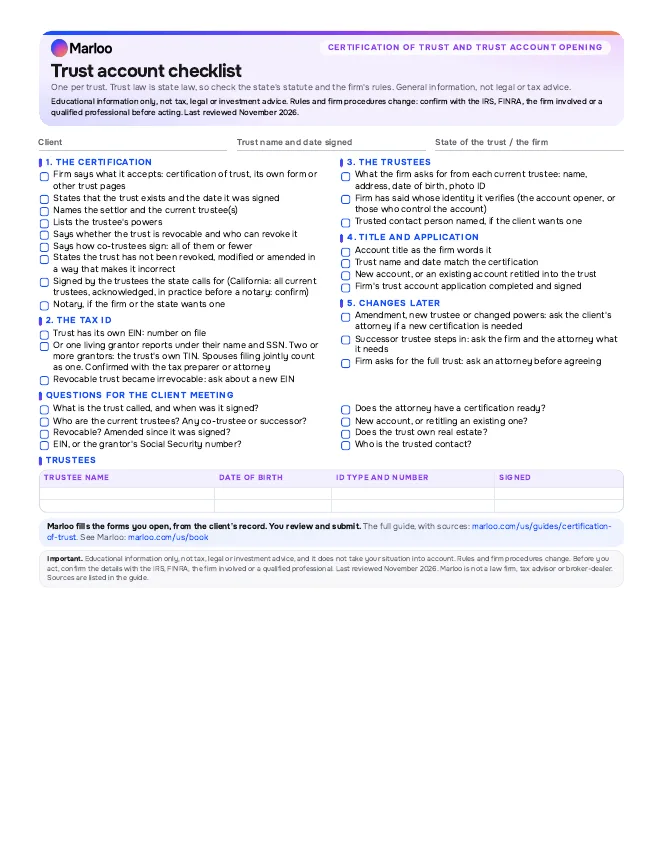
trust account checklist
One page per trust: the documents, the certification checks, the tax ID, the trustees, the title and the questions for the meeting. Print it or keep it with the client file.
Download the PDFOne page, US Letter.
Where Marloo fits
Marloo fills the forms you open, from the client's record. You review and submit. It is the AI CRM for financial advisors, so each client's trusts and accounts sit in one record.
Filling the trust paperwork at Schwab or Fidelity
Schwab and Fidelity each have their own trust account paperwork. Fidelity publishes a Fidelity Certification of Trust form, and says that instead of completing it you can provide pages of the trust document that show the trust's name, date, trustees and signatures. Schwab publishes a Schwab One Trust Account Application. Use each firm's current form, and ask whether it will take a certification drafted by the client's attorney in place of or alongside its own. Marloo fills the forms you open, from the client's record. You review and submit.
“All we needed to do was use it once. Marloo's spoken for itself ever since.”

Certification of trust questions
A certification of trust is a short document, signed by a trustee, that proves a trust exists and says who the trustee is and what the trustee can do. It lets a bank or brokerage deal with the trustee without reading the whole trust. In the state statutes we checked, it need not include the terms that say who receives the trust property.
They name the same kind of document. The state statutes we read say "certification of trust". "Certificate of trust" and "trust certification" are what people and some firms call it. A firm's own form can ask for different content under a different name, so ask the firm what it will accept.
It depends on the state and the firm. California requires an acknowledged declaration signed by all currently acting trustees. An acknowledgment in California may be made before a notary public, and the notary's certificate verifies only the signer's identity, so confirm the detail with a notary or attorney. The Florida, Ohio and Arizona sections say a trustee may sign or otherwise authenticate it and do not mention a notary. A firm can still ask for a notarized signature, so ask the firm before the trustee signs.
The statutes differ. In Florida, Ohio and Arizona, any trustee may sign it. In California, all of the currently acting trustees sign it. With co-trustees, the certification also says whether all of them or fewer must sign to use the trustee's powers.
The full trust agreement is the whole instrument, including who receives what. The certification is a summary of the facts a third party needs, such as the trust's existence, the trustee and the trustee's powers. Florida and Ohio say a recipient may require excerpts that name the trustee and give the power to act, and they do not say a recipient may ask for nothing more. Florida, Ohio and Arizona keep the right to a copy of the trust in a court proceeding, and Florida also where another law requires it. Only Arizona and California limit broader demands: Arizona requires a verified statement giving a reasonable basis before a recipient can demand excerpts with the dispositive terms or named successor trustees, and both make a person liable for damages for a demand made without good faith (Arizona) or in bad faith (California).
The names are used loosely, and state law decides what each one is. Some states have a separate recordable instrument for real estate. Ohio, for example, has a memorandum of trust under section 5301.255, which the trustee acknowledges and which is recorded with the county recorder. If a firm or title company asks for an affidavit of trust or an abstract of trust, ask what it must say and whether a certification of trust will do, and ask an attorney if you are unsure.
A firm can ask for more than the statute lists, and the statutes allow a recipient to require excerpts naming the trustee and giving the power to act. Arizona makes a person who demands the trust instrument without good faith liable for damages, costs and attorney fees, and California does the same for a bad-faith demand for the trust documents. Whether a particular demand is reasonable is a question for an attorney.
Ask the firm which trust account application it uses and what documents it needs. Have these ready: a certification of trust or other trust documents, the trust's tax identification number (or, for some revocable trusts, the grantor's Social Security number), the identification the firm asks for from the trustees and the exact title the account will carry. The numbered steps are on this page.
Not necessarily. A revocable trust with one living grantor can sometimes use the grantor's name and Social Security number instead of an EIN: the IRS says the trustee of certain grantor-type trusts does not need an EIN if the trustee gives payers the grantor's name and taxpayer identification number and the trust's address. Under the federal regulation, a trust treated as owned by two or more grantors must furnish the trust's own name, TIN and address, and a husband and wife who file one joint return are treated as one grantor. A grantor trust that does not use the grantor-TIN method must have an EIN, and the IRS lists a revocable trust that becomes irrevocable as a reason to get a new one. The trust's tax preparer or attorney confirms which applies.
Each has its own trust paperwork, so use the firm's current form. Fidelity publishes a Fidelity Certification of Trust form for domestic trusts, and says that instead of completing it you can provide pages of the trust document that show the trust's name, date, trustees and signatures. Its help sheet says all trustees' signatures on the form must be notarized. Schwab has its own Schwab One Trust Account Application, with an online application for revocable trusts where the grantors, current trustees and beneficiaries are the same people. Ask each firm whether a certification drafted by the client's attorney will do in place of or alongside its own form.
Marloo fills the forms you open, from the client's record. You review and submit.
Sources
The statements about certifications come from the four state sections linked below, which we read in November 2026. Statutes change, and other states' versions differ, so the current text for your state is the one that counts.
- Florida Statutes section 736.1017, Certification of trust. A trustee may give a certification of trust instead of a copy of the trust instrument. What it lists, who may sign, and the protection for a person who relies on it.
- Ohio Revised Code section 5810.13, Certification of trust furnished to person not beneficiary. The same idea in Ohio, with a shorter list. It also allows the certification to show who the trustee is and who succeeds them.
- Arizona Revised Statutes section 14-11013, Certification of trust. Includes the limit on demanding trust excerpts and the liability of a person who demands the instrument without good faith.
- California Probate Code section 18100.5. California's own certification statute: what it may contain, the acknowledged declaration signed by all currently acting trustees, recording, and the liability for a bad-faith demand for the trust documents.
- Ohio Revised Code section 5301.255, Memorandum of trust recording. A separate Ohio instrument for real estate: what a recordable memorandum of trust states and how it is acknowledged.
- California Civil Code sections 1181 and 1189. An acknowledgment in California may be made before a notary public, and the notary’s certificate verifies only the identity of the signer.
- IRS, Instructions for Form SS-4 (12/2025). When the trustee of a grantor-type trust does not need an EIN, and when a grantor trust must have one.
- IRS, Instructions for Form 1041 (2025). A revocable living trust is treated as a grantor type trust, and the optional filing methods for a trust owned by one grantor.
- 26 CFR 1.671-4, Method of reporting. The regulation behind the optional methods: the trustee gives payors either the grantor’s name and TIN or the trust’s name, TIN and address.
- IRS, Do you need a new EIN?. A revocable trust that changes to an irrevocable trust gets a new EIN, and a change of trustee does not need one.
- 31 CFR 1023.220, Customer identification programs for broker-dealers. The identifying information a broker-dealer collects before opening an account, and the documents it may use to verify a customer that is a trust. 31 CFR 1023.100(d) defines the customer.
- FINRA Rule 4512, Customer Account Information. Account information a FINRA member maintains, including the tax identification number and a trusted contact person.