
Guide and checklist
ACAT transfers: how long they take, what the form asks for and how to move an account
The short answer
An ACAT transfer moves a brokerage account and its assets from one firm to another. The new firm starts it from a form you sign. As the rule text reads in November 2026, FINRA Rule 11870 gives the old firm one business day to validate the request, and then three business days after validation to complete the transfer. NSCC can change these time frames. FINRA's investor page says the two steps generally take about three to four business days in total. That page is not dated, and NSCC removed one processing day from ACATS on Oct 17, 2025, so a transfer may now be quicker. Ask both firms for their timing.
- 1 business dayFor the delivering firm to validate, Rule 11870(b)(1) as read in November 2026
- 3 business daysTo complete the transfer after validation, Rule 11870(e)
- NSCC can change themAsk both firms for their timing
- Form must matchMost delays come from an incorrect or incomplete form (SEC)
What an ACAT transfer is
People write ACAT or ACATS. FINRA and the SEC use ACATS, which stands for Automated Customer Account Transfer Service. The National Securities Clearing Corporation (NSCC) operates it, and FINRA says most customer accounts move between broker-dealers through it. DTCC lists the assets it supports as equities, corporate and municipal bonds, unit investment trusts, mutual funds, options, annuities, alternative investments and cash. It is open to eligible NSCC full-service members and DTC bank participants.
Two names to know. The new firm is the receiving firm
. The firm that holds the account now is the delivering firm
on FINRA's investor page and the carrying firm
in Rule 11870. This guide uses delivering firm.
How an ACAT transfer works
The steps and the two time limits
- The receiving firm enters the form into ACATSThe new firm starts the transfer from the form you sign.Start
- The delivering firm validates or takes exceptionRule 11870(b)(1)One business day
- The delivering firm completes the transferRule 11870(e), after validationThree business days
- Check the first statementCompare it with the last one at the old firm.After the transfer
- Open the account at the new firm and get its transfer form. FINRA says the firm you plan to move to can provide the form, and the SEC says all transfers start and end with your new firm. FINRA calls it a Transfer Initiation Form, and the SEC and Rule 11870 call it a transfer instruction form. Both are shortened to TIF.
- Fill it in exactly as the old account reads. The SEC says most delays happen because the form is incorrect or incomplete, and to give the information exactly as it appears on your old account.
- The receiving firm enters it into ACATS. FINRA says it enters data from the form, including your name, Social Security number and account number. If the data does not meet ACATS's minimum requirements, the system rejects the request automatically.
- The delivering firm validates it or takes exception. Rule 11870 gives it one business day. If it validates, it sends the receiving firm a list of the assets and money balances to be transferred.
- The receiving firm reviews the list. FINRA says the receiving firm is not required to accept the transfer, and that the most common reason for declining is its credit policies, such as margin or a minimum equity requirement.
- The delivering firm completes the transfer. Rule 11870 gives it three business days after validation.
- Check the first statement. The SEC says to compare your first statement at the new firm with your last one at the old firm, to check that every asset arrived.
How long an ACAT transfer takes
The rule sets two time limits and FINRA gives a usual total. The sources differ a little, so here is each one with its source:
| Step | Time | Source |
|---|---|---|
| Delivering firm validates the request or takes exception | One business day | FINRA Rule 11870(b)(1), as read in November 2026. NSCC can change this |
| Delivering firm completes the transfer after validation | Three business days | FINRA Rule 11870(e), as read in November 2026. NSCC can change this |
| Validation and delivery together, as FINRA describes it | Generally about three to four business days | FINRA investor page (not dated) |
| No problems (SEC, written in 2014, before NSCC removed a processing day in 2025) | About three to five business days from when the new firm enters the form into ACATS | SEC investor bulletin, June 27, 2014 |
| Request the old firm does not act on, or a problem not resolved | Purged from ACATS after two business days | SEC Investor.gov (not dated). This is not in the rule |
| Transfer outside ACATS | Up to 30 days is not uncommon | SEC investor bulletin, June 27, 2014 |
Rule 11870 says its time frames will change as NSCC publishes them, so the table shows them as the rule reads today. NSCC's rule filing, which the SEC approved in 2025, describes four stages taking up to five days, with the settlement preparation day as day four, and says removing that day shortens the transfer. According to a FINRA notice, NSCC removed it on Oct 17, 2025. The pages we read do not give a new total, so we do not state one or add the rule's two time limits together. FINRA's key topic page says the delivering firm has three business days to validate, which differs from the rule's one business day, and we follow the rule.
FINRA and the SEC list what takes longer:
- The delivering firm is not a broker-dealer. FINRA says a transfer generally takes more time when the delivering firm is a bank, credit union or mutual fund. The SEC says banks, mutual funds, credit unions, insurance companies and limited partnerships are not required to take part in ACATS, and that a bank in NSCC's ACATS for Banks program should take the standard ACATS time.
- The account needs a custodian. FINRA says an account that needs a custodian, such as an IRA or a custodial account for a minor child, may take additional time.
- Some assets do not transfer. The SEC says it may take longer while you decide how to handle them (see below).
- ACATS is not used. FINRA says when the assets cannot move through ACATS, or a party does not take part, the transfer is handled manually and can take longer. The SEC says up to 30 days is not uncommon.
Full transfer or partial transfer
Rule 11870 covers a transfer of an account in whole or in specifically designated part
. FINRA also describes ACATS as moving accounts in whole or in part. The rule writes several of its protections for whole transfers. This is what it says for each:
| In Rule 11870 | Full transfer | Partial transfer |
|---|---|---|
| What it moves | The whole account | Specifically designated assets, and the rest stays |
| How you ask | A transfer instruction form for the account, through ACATS | ACATS unless the instructions say otherwise. Outside ACATS, alternate instructions to the delivering firm that name the assets |
| Account freeze once validated | Yes. Open orders are cancelled (except options expiring within seven business days) and no new orders are taken | The rule text we read says this for whole transfers only. Ask both firms |
| Credit and debit cards, unused checks | You affirm you have destroyed or returned them (not for retirement accounts) | The rule asks this for whole transfers only |
| Receiving firm can decline | Only the entire account, and only for credit policy or minimum asset requirements | The rule speaks of whole transfers here. Ask the receiving firm |
| Credits that arrive later | Credit balances go on within ten business days, for at least six months after the transfer | The six-month rule is written for whole transfers |
A partial transfer made outside ACATS is not subject to the provisions of the rule, but the rule still says members must expedite and coordinate all authorized transfers. We did not find a source saying a partial transfer is faster or slower than a full one, so we do not claim either.
What can stall or stop a transfer
- The form does not match the old account. Rule 11870 lets the delivering firm take exception if the Social Security number or tax ID does not match, if the account title does not match, if the account type does not match, or if the authorization is missing or improper.
- Other listed reasons. The rule also lists a request that needs more documentation (it gives a death or marriage certificate as examples), a flat account with no transferable assets, an invalid account number, a duplicate request, a request that violates the firm's credit policy, residual credit assets the receiving firm cannot match to the customer, a rescinded request and a customer who has taken possession of the assets. The delivering firm may not take exception over a dispute about positions or the money balance.
- The receiving firm declines. After validation it can reject a whole-account transfer only for its credit policies or minimum asset requirements, and it must reject the entire account, not part of it.
- Nontransferable assets. Rule 11870 names proprietary products of the delivering firm (nontransferable unless the receiving firm agrees to take them), third-party funds the receiving firm has no arrangement to hold, assets the receiving firm cannot hold because of limits on its business, certain bankrupt issues, issues whose proper denominations cannot be obtained, and limited partnership interests in retail accounts. The SEC's 2014 bulletin adds fractional shares as an example. The firm contacts you in writing about them, the options can include selling (with any liquidation fees), keeping the asset with the delivering firm or having it sent to you. Once you tell the firm to sell or send an asset, it must pay out the proceeds or start the transfer within five business days (Rule 11870(c)(5)). The SEC says selling may affect your taxes, so ask a tax advisor first.
- Trading during the transfer. FINRA says trading often complicates and delays a transfer, and that some firms freeze the account until it is done.
- Nobody acts. The SEC's Investor.gov page (not the rule) says a request the old firm does not act on, or a problem not resolved within two business days, is purged from ACATS, and the new firm must start over.
What the ACAT transfer form asks for
Each firm has its own form. The sample transfer instruction form in Rule 11870 shows what the rule expects it to cover:
- The date, the receiving firm and the delivering firm
- The account number at each firm
- The account title
- The account type: cash or margin on the standard sample form, IRA or qualified on the retirement sample
- The tax ID or Social Security number
- Your acknowledgments: assets that are not readily transferable may not move in the rule's time frames, the delivering firm will contact you about nontransferable assets, and you have destroyed or returned any credit or debit cards and unused checks (for a whole account that is not a retirement account)
- Your signature and date
The rule says your authorization can be your actual signature or an electronic signature in a format recognized as valid under federal law to conduct interstate commerce.
Fees, cutoffs and what the rules do not say
After the transfer
- Compare the first statement at the new firm with the last one at the old firm.
- Rule 11870 has the delivering firm pass on transferable assets that accrue to the account after the transfer, such as a late dividend. For a whole-account transfer, firms must transfer credit balances within ten business days after they accrue, for at least six months after the transfer.
- If the transfer is late, the SEC says to ask for the compliance director at both firms, and to contact the SEC, FINRA or your state securities regulator if you are not satisfied.
For advisors
Moving a client account by ACAT: a checklist for the client file
What to collect
- The delivering firm's account number and the receiving firm's account number
- The account title exactly as the delivering firm has it, and the account type (cash or margin; IRA or qualified for a retirement account)
- The tax ID or Social Security number on the delivering firm's records
- The client's signature on the receiving firm's transfer form. An electronic signature works if it meets the rule's test
- A copy of the most recent statement. The rule's sample forms suggest attaching one, and the rule requires it only to resubmit after a flat-account exception
- Full or partial, and for a partial, the exact assets
- For an IRA or other retirement account, the receiving firm's custodian or trustee approval before the request goes in
- A list of assets that may not move: proprietary products, funds the receiving firm cannot hold, fractional shares, limited partnership interests
Retirement and custodial accounts
- FINRA says accounts that need a custodian, such as an IRA or a custodial account for a minor child, may take additional time. Set the client's expectation before you send the form.
- Rule 11870 has the delivering firm tell the client that the way nontransferable retirement assets are handled may lead to taxes and penalties. Outstanding custodian fees are taken from the credit balance, by selling assets, or moved to the receiving firm as a debit item. We cannot tell the client which choice is right. The client's tax advisor can.
One thing to watch
FINRA has warned member firms about fraudulent ACATS transfers, where someone opens an account in a real customer's name with stolen information and then sends a form to move that customer's assets. If a client says they did not ask for a transfer, we suggest telling the delivering firm at once. We also suggest confirming a new transfer request with the client at a phone number you already hold.
Questions to ask in the client meeting
- Which accounts are moving, and is each a full or a partial transfer?
- What type is each account: cash, margin, IRA or custodial?
- Does the account hold anything proprietary to the old firm, a fund the new firm may not carry, fractional shares or a limited partnership?
- If an asset cannot move, should it be sold, left behind or sent to the client? Has the client talked to a tax advisor?
- Is the client placing trades, and can they pause until the transfer is done?
- What will each firm charge, and who is asking for a waiver?
- Where is the latest statement, and does the account title match it?
- When did the client last receive dividends or interest that could land after the transfer?
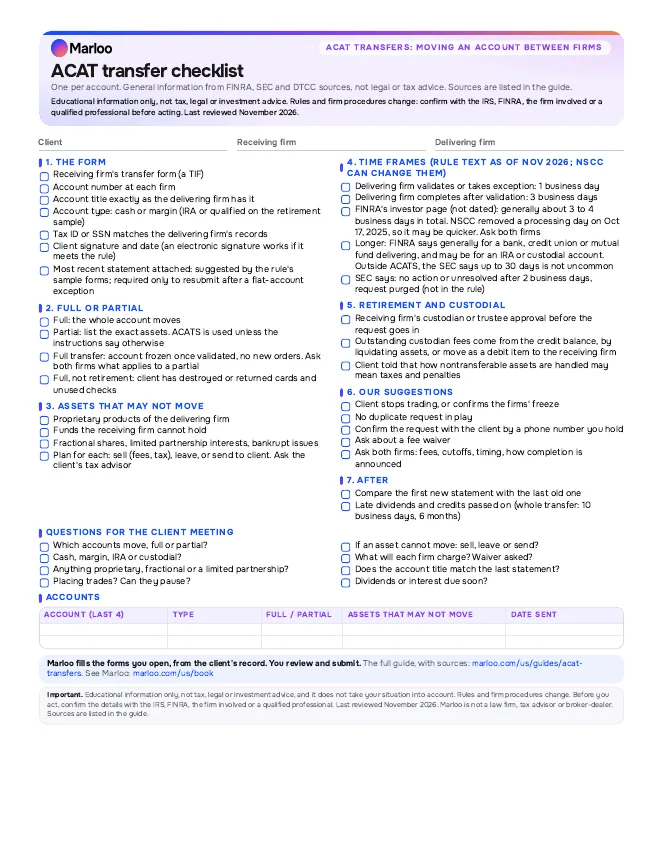
ACAT transfer checklist
One page per account: the form details, full or partial, the assets that may not move, retirement checks, the time frames and the questions for the meeting. Print it or keep it with the client file.
Download the PDFOne page, US Letter.
Where Marloo fits
Marloo fills the forms you open, from the client's record. You review and submit. It is the AI CRM for financial advisors.
“Marloo is like having another staff member sit in on the meeting, leaving me able to build rapport with clients, talk about their families and get to know them. Everything's recorded, and once the meeting's over Marloo filters it for you, and you're getting to the information you really need quickly.”

ACAT transfer questions
An ACAT transfer moves a brokerage account and its assets from one firm to another through ACATS, the Automated Customer Account Transfer Service. The National Securities Clearing Corporation (NSCC) operates ACATS, and FINRA says most customer accounts move between broker-dealers this way. People also write it as ACAT or ACATS. The new firm, called the receiving firm, starts the transfer from a form you sign. The firm that holds the account now is the delivering firm.
FINRA's investor page says the validation and delivery steps generally take about three to four business days in total. That page is not dated, and NSCC removed one processing day from ACATS on Oct 17, 2025, so a transfer may now be quicker. Ask both firms for their timing. As the rule text reads in November 2026, FINRA Rule 11870 gives the delivering firm one business day to validate the request or take exception, and then three business days after validation to complete the transfer. NSCC can change these time frames. An SEC bulletin written in 2014, before the 2025 change, says about three to five business days when there are no problems. FINRA says transfers generally take more time when the delivering firm is a bank, credit union or mutual fund, and may take more time when the account needs a custodian, such as an IRA. The SEC adds that a bank in NSCC's ACATS for Banks program should take the standard ACATS time. Transfers outside ACATS can take much longer; the SEC says up to 30 days is not uncommon.
It is the transfer form you sign and give to the new firm. FINRA calls it a Transfer Initiation Form and the SEC and Rule 11870 call it a transfer instruction form, both shortened to TIF. FINRA's sample form in the rule asks for the receiving and delivering firm account numbers, the account title, the account type (cash or margin on the standard sample, IRA or qualified on the retirement sample), the tax ID or Social Security number and your signature and date. The SEC says to give the requested information exactly as it appears on the old account, because most delays come from a form that is incorrect or incomplete. The new firm can provide the form.
A full transfer moves the whole account. A partial transfer moves specifically designated assets and leaves the rest. Rule 11870 covers both, and says ACATS is used for partial transfers unless the instructions say otherwise. A partial transfer can also be done outside ACATS, by sending alternate instructions to the delivering firm that name the assets, and the rule says such transfers are not subject to its provisions, though firms must still expedite them. Several protections in the rule are written for whole-account transfers, such as the account freeze once the request is validated. The rule does not say the same for a partial transfer, so ask both firms.
Only for the reasons Rule 11870 lists. They include: additional documentation is required, the account is flat with no transferable assets, the account number is invalid, the request is a duplicate, the customer has rescinded it, the Social Security number or tax ID does not match, the account title does not match, the account type does not match, the request violates the firm's credit policy, there are residual credit assets the receiving firm cannot match to the customer, the authorization is missing or improper, or the customer has taken possession of the assets. The delivering firm may not take exception over a dispute about positions or the money balance. After validation, the receiving firm can reject a whole-account transfer only because the account does not meet its credit policies or minimum asset requirements.
FINRA says buying and selling during a transfer often complicates and delays it, and that it is often best to avoid trading. Some firms freeze an account being transferred, so no trades are allowed until it is done. Under Rule 11870, once a whole-account transfer is validated, the delivering firm cancels all open orders, except option positions that expire within seven business days, and takes no new orders. We found nothing in the rule about trading before validation, so ask both firms what applies to your account.
Rule 11870 calls these nontransferable assets: a proprietary product of the delivering firm (nontransferable unless the receiving firm agrees to take it), a third-party fund (such as a mutual fund) the receiving firm has no arrangement to hold, an asset the receiving firm cannot hold because of regulatory limits on its business, certain bankrupt issues, issues whose proper denominations cannot be obtained, and limited partnership interests in retail accounts. The SEC adds fractional shares as an example in its 2014 bulletin. The firm must tell you in writing what its options are, which can include selling (with any fees), leaving the asset where it is or having it sent to you. Once you tell the firm to sell or send an asset, it must pay out the proceeds or start the transfer within five business days (Rule 11870(c)(5)). Selling can affect your taxes, so ask a tax advisor first.
The rules we read do not set a transfer fee. The SEC says to ask both firms about their fees, and says the old firm may charge a fee for the transfer and the new firm may too. Fees are typically in the account agreements. For a retirement account, some firms charge a transfer-out fee and a prorated custodial fee. Rule 11870 also lets liquidation fees apply when a nontransferable asset is sold, and lets the retirement custodian deduct outstanding fees from the account.
Rule 11870 has provisions for retirement plan accounts. The receiving firm must get the approval of its custodian or trustee before it submits the transfer instruction. FINRA says transfers of accounts that need a custodian, such as an IRA, may take additional time. Outstanding custodian fees come out of the credit balance, by selling assets, or move to the receiving firm as a debit item. The delivering firm must tell you that how you handle nontransferable assets may mean taxes and penalties. Ask a tax advisor before you choose.
Stay in touch with both firms and ask what has to be fixed. The SEC's Investor.gov page (not the rule) says that if the old firm takes no action, or a problem is not resolved within two business days, the request is purged from ACATS, FINRA is notified and the new firm must enter it again. The SEC's bulletin also says to ask for the compliance director at both firms if a transfer is late, and to contact the SEC, FINRA or your state securities regulator if you are not satisfied.
Compare your first statement at the new firm with your last statement at the old firm to check that every asset arrived. If a dividend, interest or other credit reaches the old account after the transfer, Rule 11870 has the old firm pass it on. For a whole-account transfer, the rule requires firms to transfer credit balances within ten business days after they accrue, for a minimum of six months after the transfer.
Marloo fills the forms you open, from the client's record. You review and submit.
Sources
The statements about rules, time frames and steps come from the pages linked below, which we read in November 2026. Rules and firm practices change, and the SEC bulletin is from 2014, so the current rule text and your firm's own instructions are the ones that count.
- FINRA Rule 11870, Customer Account Transfer Contracts. The rule behind ACAT transfers: the one-business-day validation, the three-business-day completion, whole and partial transfers, the reasons for exceptions, nontransferable assets, retirement accounts and the sample transfer forms.
- FINRA, Brokerage Accounts - Account Transfers. FINRA’s investor page: how a transfer starts, the receiving and delivering firm, the usual total time, what takes longer and tips for a smooth transfer.
- FINRA, Customer Account Transfers (key topic). How a transfer begins, what happens when ACATS is not used and the customer’s right to move an account. Its validation time frame differs from the rule, so this page follows the rule.
- SEC Investor.gov, Transferring Your Brokerage Account. The transfer instruction form, why most delays come from an incorrect or incomplete form, and when a request is purged from ACATS.
- SEC Investor Bulletin, Transferring Your Investment Account (June 27, 2014). Timing, assets that may not transfer, fees, transfers that do not use ACATS and what to do if a transfer is late. It is from 2014, so check its timing against the FINRA page.
- DTCC, Automated Customer Account Transfer Service (ACATS). What ACATS is, the assets it supports and who can use it.
- FINRA Reminds Firms That NSCC Has Modified the ACATS Transfer Process (Information Notice, Oct 21, 2025). NSCC removed the settlement preparation day from the ACATS transfer process on Oct 17, 2025.
- SEC order approving NSCC rule change SR-NSCC-2025-011 (Federal Register, Sep 10, 2025). Describes the four stages of an ACATS transfer, taking up to five days, before the settlement preparation day was removed.
- FINRA Regulatory Notice 22-21, Heightened Threat of Fraud. How bad actors have used ACATS to move assets out of a real customer’s account.